
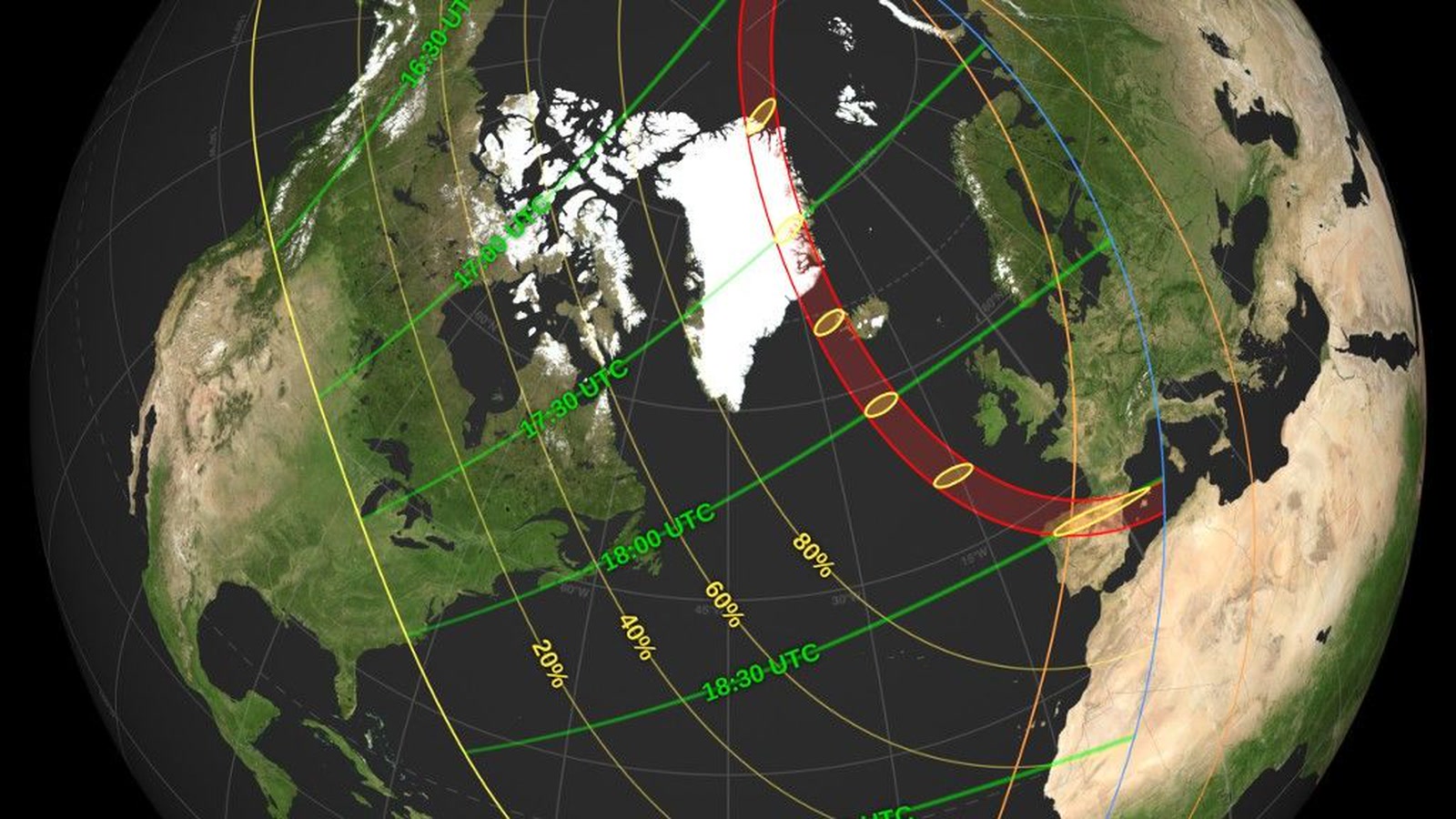
The quickest way to know what you will see on August 12 is to check whether your location falls inside the narrow path of totality or only inside the much larger partial-eclipse region. Greenland, Iceland, northern Russia, parts of Spain, and a small corner of Portugal cross the total path. Most of Canada is outside that band and will see only part of the Sun covered.
The distinction controls both the view and the safety rules. Inside totality, the Sun is completely covered for a short interval. Outside it—even if 99 per cent is covered—the bright part of the Sun remains exposed and certified solar protection is required throughout.
CTV News highlighted how scientists map the path. This guide turns that map into a practical location check for viewers preparing one day before the event.
Step 1: Find the path, not just the eclipse date
NASA’s August 12 eclipse map uses a red band for totality. That band follows the Moon’s umbra, the darkest central part of its shadow. Broader contours mark the penumbra, where only a partial eclipse is visible.
A city name near the red band is not enough. The total path has sharp geographic edges: two places separated by a modest driving distance can have very different experiences. Enter the exact viewing location in a reputable interactive eclipse map and confirm whether it says “total” or “partial.” Save the contact times and the stated time zone.
Maps can look unusual near the North Pole because a flat projection distorts the route. Use the location result rather than guessing from the apparent direction of the curved line.
Step 2: Check the local contact times
An eclipse is a sequence, not a single timestamp. First contact is when the Moon starts covering the Sun. Maximum eclipse is when coverage is greatest at that location. Last contact is when the Moon moves clear. Locations in totality also list when totality begins and ends.
| Selected location | Partial begins | Maximum or totality | Partial ends |
|---|---|---|---|
| Edmonton, Alberta | 10:02 a.m. MDT | 10:38 a.m. MDT, about 6% coverage | 11:15 a.m. MDT |
| Winnipeg, Manitoba | 11:25 a.m. CDT | 12:02 p.m. CDT, about 5% | 12:40 p.m. CDT |
| Toronto, Ontario | 12:55 p.m. EDT | 1:40 p.m. EDT, about 8% | 2:23 p.m. EDT |
| Montreal, Quebec | 12:50 p.m. EDT | 1:45 p.m. EDT, about 18% | 2:38 p.m. EDT |
| Halifax, Nova Scotia | 1:58 p.m. ADT | 3:00 p.m. ADT, about 31% | 3:58 p.m. ADT |
| St. John’s, Newfoundland | 2:28 p.m. NDT | 3:35 p.m. NDT, about 53% | 4:37 p.m. NDT |
NASA’s published city list does not include every community. Do not transfer the nearest city’s times if you need precision for photography or an event. A few kilometres change the contact times, and time-zone settings can introduce another error.
Step 3: Confirm the Sun will be above your horizon
In Spain and other western parts of the path, the eclipse happens close to sunset. A mapped eclipse can still be blocked by terrain, buildings, trees, haze, or the horizon. Check the Sun’s altitude and direction for your exact coordinates, then choose a viewing area with an open view in that direction.
Cloud forecasts become more useful close to the event. Check an official hourly forecast on the morning of August 12, but avoid a long last-minute drive based only on a single cloud icon. Road conditions, wildfire smoke, crowd controls, and safe parking matter too.
Step 4: Use the right eye protection
Regular sunglasses are not safe solar filters. NASA and the American Astronomical Society advise using eclipse glasses or handheld viewers that meet the ISO 12312-2 standard and come from a reliable supplier. Inspect them for scratches, punctures, or separation before use.
Do not look through a camera, binoculars, or a telescope while wearing eclipse glasses. Concentrated sunlight can damage the filter and the eye. Optical equipment needs a purpose-built solar filter attached to the front, before sunlight enters the instrument.
If you do not have a safe viewer, use indirect projection. A simple pinhole can cast the Sun’s image onto a surface while your back faces the Sun. Look at the projected image—not through the hole. Small gaps between tree leaves can also project many crescent images on the ground.
When can glasses come off?
Only observers confirmed to be inside the path of totality may look without a solar filter during the brief interval when the Sun’s bright face is completely covered. Protection goes back on as soon as the bright edge reappears.
Everyone viewing a partial eclipse must keep certified protection on whenever looking toward the Sun. A 99 per cent partial eclipse is still partial; there is no safe unfiltered interval.
A five-minute preparation check
- Confirm “total” or “partial” for your exact location.
- Write down local first contact, maximum, and last contact with the time-zone abbreviation.
- Inspect your viewer and prepare an indirect method as backup.
- Check the Sun’s direction and remove horizon obstructions from the plan.
- Set an alarm 15 minutes before first contact.
- If weather blocks the view, use NASA’s live broadcast rather than taking unsafe chances on the road.
NASA’s stream begins at 1:15 p.m. EDT on August 12. It is also useful for viewers in western Canada, where the local partial coverage may be very small or absent, and for anyone whose sky is cloudy.
Sources and methodology
- NASA’s August 12 eclipse map, city times, and safety guidance
- NASA GSFC path table
- American Astronomical Society eye-safety guidance
- CTV News report on mapping totality
Methodology: We used NASA’s dated event page for locations, local times, and coverage percentages, then organized the information into a location-and-safety checklist. Weather and visibility still need to be checked locally on August 12.